

 Tiếng Việt









Headquarters is a common term in business management and corporate law. It refers to the central place where a company runs its main operations. However, many people still do not fully understand what headquarters means or which legal regulations apply to it. This article by Inspire Hub will explain the concept clearly and summarize the important legal points that businesses need to know.
What is headquarters?
Headquarters is the central location where an organization or a business manages its main operations. It is the place where senior leaders make key decisions and coordinate all branches and related units. According to Article 42 of the Law on Enterprises 2020, a company’s headquarters (referred to as the head office in the official English translation) must be located within Vietnam’s territory, must serve as the company’s contact address, and must be determined based on administrative boundaries.
Key features of a headquarters
A headquarters usually has the following legal and operational features:
- Full legal status: It is the official address listed on the Enterprise Registration Certificate and carries a unique enterprise code.
- Official contact address: It includes a phone number, a fax number, and an email address, if available, for communication with government agencies and business partners.
- Tax function: It is normally the place where a company declares and pays its main tax obligations.
- One location per company: Each company has only one headquarters, unlike branches or business locations, which can exist in several places.
- Mandatory sign display: Under Clause 4, Article 37 of the Law on Enterprises 2020, a company must display its name at its headquarters.

Legal regulations on headquarters
To operate legally and transparently, a company must strictly follow the current regulations when it sets up and maintains its headquarters. Below are the main legal rules that every business should understand.
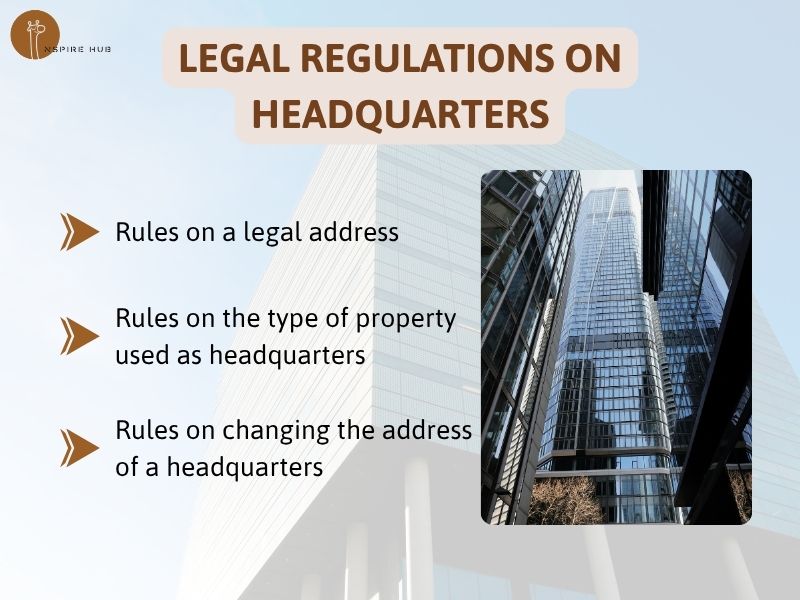
Rules on a legal address
A company must prove that it has the legal right to use the address of its headquarters. If the company owns the property, it needs a Certificate of Land Use Rights or House Ownership. If the company rents the property, it needs a valid lease agreement with a party that has the legal right to lease it.
Under the Law on Housing 2014, the law does not allow a company to use a residential apartment as a business headquarters. A legal address must be located in an office building or in real estate with a suitable commercial function.
Rules on the type of property used as headquarters
A headquarters must be located in real estate with a function that matches the company’s business activities, such as an office building, a shopping center, or a commercial space. For a virtual office model, a company can fully register that address as its legal headquarters on its business license.
Rules on changing the address of a headquarters
The process of registering a change of headquarters address is specified in Decree 168/2025/ND-CP on enterprise registration. Under Article 40 of this Decree, a company must complete the registration process at the Business Registration Office located where the company has its headquarters and must submit documents proving the legality of the new address.
It is worth noting that if administrative boundaries change due to the merger of provinces or cities, a company does not have to update its Enterprise Registration Certificate, following the guidance of the Ministry of Finance and the regulations under Decree 01/2021/ND-CP.
The difference between headquarter and head office
Many people confuse the terms headquarter and head office. Although both relate to the main office of a company, they carry different meanings in international business practice. The table below explains this difference in more detail.
| Criteria | Headquarter | Head Office |
| Definition | The center of operations and top level strategic decisions for the entire system | The main office where daily management and administrative tasks take place |
| Scope of use | Usually used for large corporations or multinational groups with many branches and subsidiaries | More commonly used for small and medium sized businesses or in everyday business language |
| Legal status | Directly linked to the official registered address on the business license | May be the main office but sometimes serves only an operational purpose, not always the sole legal address |
| Scale | Usually large in scale with a full senior management structure such as a board of directors | The scale can be more flexible depending on the organizational structure |
| Number | Each company or group has only one headquarters | The term regional head office may be used, though it still refers to a single legal headquarters |
If your company prefers full control over the workspace and is ready for a longer commitment, a traditional office lets you design and fit out the space to your brand – typically under a 3–5 year lease.
Criteria for choosing a suitable headquarters location
When choosing a location for a headquarters, a company should consider the following important criteria to stay compliant with the law and to improve operational efficiency:
- Legal validity of the address: Make sure the address has complete legal documents and does not belong to a type of property banned from use as a headquarters, such as a residential apartment.
- Convenient location: Choose a place near commercial centers that is easy for partners, customers, and government agencies to reach.
- Room for expansion: Choose a location that can support future growth in staff numbers and business activities.
- Operating cost: Budget is often the deciding factor when choosing where to set up your headquarters. Balance the cost of renting or buying the property against the brand value that the address provides. Get a realistic picture of office rental costs in Ho Chi Minh City before you commit.
- Brand image: An address in a reputable area usually creates a better impression with partners and investors.
For teams that need privacy and a professional image without the heavy setup of a traditional lease, a private office inside a serviced building still provides a valid legal address for registration.
Frequently asked questions (FAQs) about headquarters
How is a headquarters different from a branch, a business location, and a representative office?
These four terms have completely different legal functions:
- A headquarters is the official, single registered address that carries the company’s enterprise code.
- A branch is a dependent unit that can carry out business activities and has its own tax code, and it may be located in a province or city different from the headquarters.
- A representative office only handles transactions and marketing and cannot directly conduct profit making business.
- A business location does not have its own tax code, and if it is in the same province as the headquarters, the headquarters will declare and pay tax on its behalf.
Can one address hold more than one headquarters?
Under the legal principle, each company can have only one headquarters. However, one address, such as an office building or a virtual office, can be used as the headquarters for several different companies, as long as each company meets its own separate registration requirements.
Can a virtual office be registered as a headquarters?
Current law does not prohibit the use of a virtual office as a registered headquarters address, as long as the address is real, legal, and meets all the conditions under the Law on Enterprises 2020. A company should choose a reputable service provider with clear legal documents and a transparent service contract to avoid legal risks.
What are the rules for displaying a sign at a headquarters?
Under Clause 4, Article 37 of the Law on Enterprises 2020, a company must display a sign at its headquarters, branches, representative offices, and business locations. The sign must clearly show the company name as stated on the Business Registration Certificate, the enterprise code, the headquarters address, and the phone number, if available. Failure to display a sign can lead to an administrative fine of 10 to 15 million Vietnamese dong under Decree 122/2021/ND-CP.

Overall, a headquarters is not simply an administrative address. It is the core legal and operational center of every company. Understanding the legal rules on a valid address, a suitable type of property, and the process for changing a headquarters will help a company run smoothly and avoid administrative violations. Learn more useful information about office spaces at the Inspire Hub website.